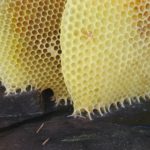
Beeswax (cera alba) is a natural wax produced by honey bees of the genus Apis
Young worker bees are given the job of making beeswax for the colony
Soon after a young worker bee emerges into an adult it begins producing wax
Beeswax is made from honey. Young worker bees collect nectar and pollen to make honey, as they eat the honey their bodies make wax
The young worker bees have 4 pairs of special wax secreting glands on the underside of their abdomens. From these glands they secrete liquefied wax, which hardens into thin scales when exposed to air
After the wax hardens the young worker bee uses stiff hairs on her hind legs to remove the wax from her abdomen. She passes the wax forward to her middle legs and then to her mandibles. She chews the wax to make it pliable and then carefully shapes it into hexagonal cells that make up the honeycomb. She uses her mouth to measure the thickness of the honeycomb as they build in order to know if more or less wax is needed
Beeswax is the foundation of a bee hive
During peak production, a healthy worker bee can produce about 8 scales of wax in a 12 hour period
The bee colony needs about 1000 wax scales to make 1 gram of beeswax
The production of bees wax is essential to the bee colony. It is used to build the honeycombs in which bees raise their brood and store surplus honey for the winter
Worker bees only live for about 35 days in the summer, with the most wax being produced during the 10th to 16th days of their lives
Bees need to consume about 2.5 to 3.6 kilograms of honey to produce about 450 grams of wax
Young / fresh wax is usually white in colour and darkens with age and use
Beeswax is one of the most versatile products made naturally by an insect